
By Sipho Matshie
Is international law, really law? This question often surfaces when violations of international law occur without accountability. Of late, the question dominated media platforms and was topical in the international community when the United States of America (USA) engaged in what was termed gross violation of international law.
The merits of the question will be discussed below. At this stage, it suffices to state that the fundamental source of this question is rather the frustration by observers, academics, students and government officials who witness infringement of international law with impunity.
What then follows is yet another salient question: whose violations matter most? In other words, whose violations of international law ought to receive serious condemnation and punitive measures? These critical questions are revisited in the following paragraphs, save to state that they contribute to the hullabaloo which problematises the legitimacy of the international legal system as a result of the acts by the USA.
In this work, I narrow the discussion between two instances by the USA. The first concerns the unilateral directive issued by the President of the USA, Donald Trump, calling for the closure of Venezuelan airspace. The second relates to charges of narcoterrorism brought against the President of Venezuela, Nicolás Maduro. In my view, these acts are unjustifiable and utterly against the prescripts of international law. Considering that no concrete action was taken to rectify these international harms, I proceed to discuss the concerns by the international community, highlighted above on the legitimacy of international law.
The Two Atrocious Acts against Venezuela
- The Unilateral Closure of the Venezuelan airspace
Sovereign equality and non-intervention are some of the key tenets of international law, authoritatively codified in article 2(1) and article 2(7) respectively, of the United Nations Charter (the UN Charter). The unilateral directive by the USA regarding the closure of Venezuelan airspace raises serious concerns under these provisions. Similarly, the Convention on International Civil Aviation (the Chicago Convention) stipulates that ‘every State has complete and exclusive sovereignty over the airspace above its territory’ (article 1). This means that it is rather Venezuela, through its airspace sovereign powers, that has the complete authority to either open or close its airspace. As a result, the act of the USA has completely undermined the Chicago Convention.
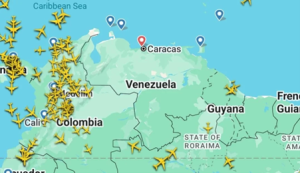
Figure: Venezuelan airspace promptly after the announcement by USA President, Donald Trump. Source: https://aviationghana.com/airlines-avoid-venezuelan-airspace-following-us-backed-closure/
Although the position of international aviation law is clear on airspace, the commandment by the USA appeared to have worked with many airlines having avoided the airspace henceforth. This was a regrettable moment in the international community, as it constituted an encroachment upon the internal affairs of a sovereign state.
The effects of the above international law harm were obviously felt by airlines, crew and passengers alike. Avoiding the Venezuelan airspace meant that there was an increase in fuel usage by aircrafts, longer flying times and extended working periods for the crew onboard. This demonstrates how the USA can disrupt the global order without any legal authority.
- Charges of Narcoterrorism against President Nicolás Maduro
President Madura was abducted by a helicopter to the USA to stand trial, after being accused of an ‘extensive drug-trafficking operation that flooded the US with thousands of tonnes of cocaine’, falling under the scheme of Narcoterrorism. The following passage in the indictment is interesting:
NICOLAS MADURO MOROS, the defendant, is at the forefront of that corruption and has partnered with his co-conspirators to use his illegally obtained authority and the institutions he corroded to transport thousands of tons of cocaine to the United States.
The full indictment can be found here. Interestingly, under the USA law, anyone convicted of such crime can face life in jail. President Maduro has already pleaded not guilty and it is now upon the USA to prove his guilt for a successful conviction.
As a point of departure, the UN Charter does not authorise any state to unilaterally act against any contraventions of international law it may complain of. The UN functions predominantly through the UN Security Council (UNSC) and absent any resolution from the UNSC means that the UN Charter basically lack enforcement mechanisms. This means that the USA cannot enforce international law unilaterally but must do so through the broader framework of the international legal system.
Under Articles 39 to 42 of the UN Charter, the UNSC is entrusted with the primary responsibility for maintaining international peace and security. The UNSC alone has the authority to determine the existence of a threat to the peace, breach of the peace, or act of aggression, and to authorise enforcement measures. In that respect, the arrest of President Maduro is devoid of any merit as far as international law is concerned.
Even if the USA focuses on its domestic law, the intricate international law questions above remain prevalent. In addition, it is beyond question that Heads of States enjoy personal immunity arising from customary international law. This means that they are essentially absolved from any arrest or prosecution by other states. While immunity itself is not absolute, the USA lacks the authority to relax this international principle. In this respect, President Maduro is entitled to invoke personal immunity in the domestic court against the charge brought the USA.
Is international law really law?
This question, while seemingly straightforward, is profoundly complex and remains unresolved among international legal scholars. The question continues to be debated with no sign of an imminent unanimity. The critics of international law often cite inability of international institutions such as the United Nations (UN) to hold powerful states accountable as a clear indication that this legal system is not law in the “traditional” sense.
The fact that international law is inherently based on voluntarism and state consent is yet another ground vociferously advanced to criticize this law (Oana, 2005). Proponents of this argument appear to be cautioning that this law is based on political will and not necessarily on legal obligations. For instance, participation from international instruments which introduce international courts is voluntary and no state is bound by such instruments unless it is a member thereof. Instruments such as the Rome Statute, a foundational treaty of International Criminal Court (ICC) and Statute of the International Court of Justice, which establishes International Court of Justice (ICJ) are two which notably apply only in the event of a state having signed as a member.
Conversely, defenders of international law reject some of the arguments above and maintain that this legal system does not have to mirror domestic law. Its operation is to maintain international order and strengthen diplomatic relations. In other words, violations do not negate existence of this legal system, instead expose power imbalances (Krisch, 2005). Building from this perspective, the USA is used as a perfect example of power imbalance in the international arena. Be that as it may, whose violations of international law matter the most?
It has always been said that international law is biased and serves as a tool of powerful states (Goldenziel, Blockberger and Granholm, 2025). I am inclined to agree. It appears that this legal system is merely a voice of politicians, masquerading as law. Such voice is powerful only when these politicians from powerful states stand to gain economically or otherwise but becomes meaningless when small or weaker states suffer international harms. The ICJ affirmed in Nicaragua v. United States (Nicaragua case) that even the powerful states are not above the law but in recent times, the court’s caution appears to have caught academic dust and plays no significant role in the international community. The USA continues to defy international law and quite frankly, and evidently, this state appears to be above the [international] law. In fact, the USA used its UN veto powers to stop compensation towards the state of Nicaragua, despite the latter having successfully obtained an affirmative order at the ICJ.
It can be safely argued that violations of international law by small or so-called weaker states are those who matter (Snidal, Duncan, et al, 2024). In addition, the United Nations itself can be said to exist to control and perpetuate neo-colonialism through the UNSC, mainly by the five permanent members (China, France, Russian Federation, the United Kingdom, and the United States). Krisch argues that ‘powerful states tend to use international law as a means of regulation as well as of pacification and stabilization of their dominance’ and this is apparent from the work of the USA, as one of the permanent members of the UNSC.
These permanent members or best referred to as guardians of international law, enjoy immunity, to the extent that their violations of international law in fact do not matter (Radzi, 2020). The UN speaks through the UNSC (article 94 of the UN Charter) which is arguably in control by the five permanent states, each enjoying veto powers against any resolution the UNSC may take. Therefore, if one considers the instance of the USA, it really denotes a situation where the international community expects a violator of law to simultaneously reprimand oneself.
Concluding remarks
The reality is that international law exists albeit in an unequal fashion. Indeed the essence of the rule of law lies in its enforcement and that is a challenge in international law. Be that as it may, inadequate or poor enforcement cannot negate existence of international law. I do admit that when powerful states, such as the likes of USA, appear to violate international law without consequence, skepticism about the legitimacy and equal application of this legal system intensifies.
The case of Madura has potential to create an unwarranted precedent in the international community. The UN Charter is clear on how states must resolve disputes, and an act of capture, detention and forceful trial is likely to create international instability. Such act would further render state sovereignty and non- intervention meaningless. More states shall follow and use their domestic legal systems to enforce disputes which are jurisdictionally positioned for the international arena and in the process, undermine the legitimacy of international law.
Bibliography
Case law
Nicaragua v. United States
International Instruments
Charter of the United Nations
Convention on International Civil Aviation
Journal articles
Goldenziel JI, Blochberger SM and Granholm T, ‘Weapon of the Weak: Lawfare and State Power in the International Court of Justice’ (2025)
Hathaway, Oona A. “Between power and principle: An integrated theory of international law.” The University of Chicago Law Review (2005)
Krisch, Nico. “International law in times of hegemony: unequal power and the shaping of the international legal order.” European Journal of International Law 16.3 (2005)
Radzi, Ahmad Ibrahim Bin Mohd. “Weaknesses of International Law.” (2020)
Snidal, Duncan, et al. “The power of the “weak” and international organizations.” The Review of International Organizations 19.3 (2024)
About the author:
Sipho Matshie is an LLB graduate and Master of Laws student, majoring in Aviation Law, at the University of South Africa. He currently serves as a Candidate Attorney at University of South Africa’s Law Clinic. He writes here in his personal capacity.